The Science Fiction Review Movies,Technology R2-D2 Limited Edition Home Theater Projector by Nikko

R2-D2 Limited Edition Home Theater Projector by Nikko

Nikko R2-D2 home theater

I just ran across possibly the most awesome Star Wars item ever. Nikko America has a special edition remote control R2-D2 home theater audio/video projector that does just about everything. It has a ton of features, including being able to project on the ceiling (not sure I’d ever use that), official sounds, and a ton of inputs including an iPod dock. The tech specs are pretty good, but I’m sure you can build your own home theater that is better with less than the $2900 price tag. It won’t have the massive geek factor that R2-D2 has though. Be sure to check out the video to see it in action.

2 thoughts on “R2-D2 Limited Edition Home Theater Projector by Nikko”

  1. Odd, looks like the website is down. It was a pretty good concept, but I think it was more of a gimmick than anything else. I vaguely remember that it was very expensive.

Leave a Reply

Your email address will not be published. Required fields are marked *

Please prove you are a human * Time limit is exhausted. Please reload the CAPTCHA.

This site uses Akismet to reduce spam. Learn how your comment data is processed.

Related Post

The Age of Spiritual Machines by Ray KurzweilThe Age of Spiritual Machines by Ray Kurzweil

The Age of Spiritual Machines Book Cover
A few months ago a co-worker of mine suggested that I read The Age of Spiritual Machines: When Computers Exceed Human Intelligence by Ray Kurzweil. We had been talking about AI and he mentioned that this was an interesting read. I wasn’t sure exactly what to expect, as I had never heard of Kurzweil before. After a few Google searches I got the impression that he was a quirky futurist.

This book was published back in 1999 and by the end looks very much like science fiction. Many of his predictions are founded on some sort of research. I can see how they would have seemed a bit “out there” almost 10 years ago. I wondered how many of his predictions would hold up. Central to his philosophy is the Law of Accelerating Returns. In short, technology will continue to progress ever faster as time goes on. He displays an interesting graph of the exponential increase of computational power in various models of computers over time. The line is slightly curved upward, which represents an increase in exponential growth over time. So, according to Kurzweil computation is progressing exponentially exponentially faster.
(more…)

Dune (1984)Dune (1984)

Dune Movie 1984

The 1984 Hollywood version of Dune directed by David Lynch could best be described as a poor attempt to cash in on one of the best science fiction novels of our time. I highly doubt that anyone that has not read Dune by Frank Herbert could possibly understand how bad the movie was compared to the book. I have only the vaguest of memories from the first time I’ve watched Dune back when I was a little kid. I don’t remember it being one of my favorite movies like the Star Wars Trilogy. Anyway, I decided to watch the movie once again after reading the novel, which I just reviewed.

I watched this movie last week with my wife who has seen approximately 10-15 times. She read the first three Dune novels about 10 years ago, and hadn’t seen the movie for at least 5 years or more. We didn’t realize how comical the movie was compared to the book until I started pointing out the blatant discrepancies. Still, it has a completely pointless gratuitous scene with Sting emerging from some type of steam shower in a speedo, which is one of the best parts of Dune according to my wife. I think that it looks more like Flash Gordon’s underwear rather than a speedo. Anyway, I’ll move on to the review, to be followed by a spoiler-filled list of major discrepancies with the book. (more…)

Happy Birthday Isaac Asimov – plus predictions for 2014Happy Birthday Isaac Asimov – plus predictions for 2014

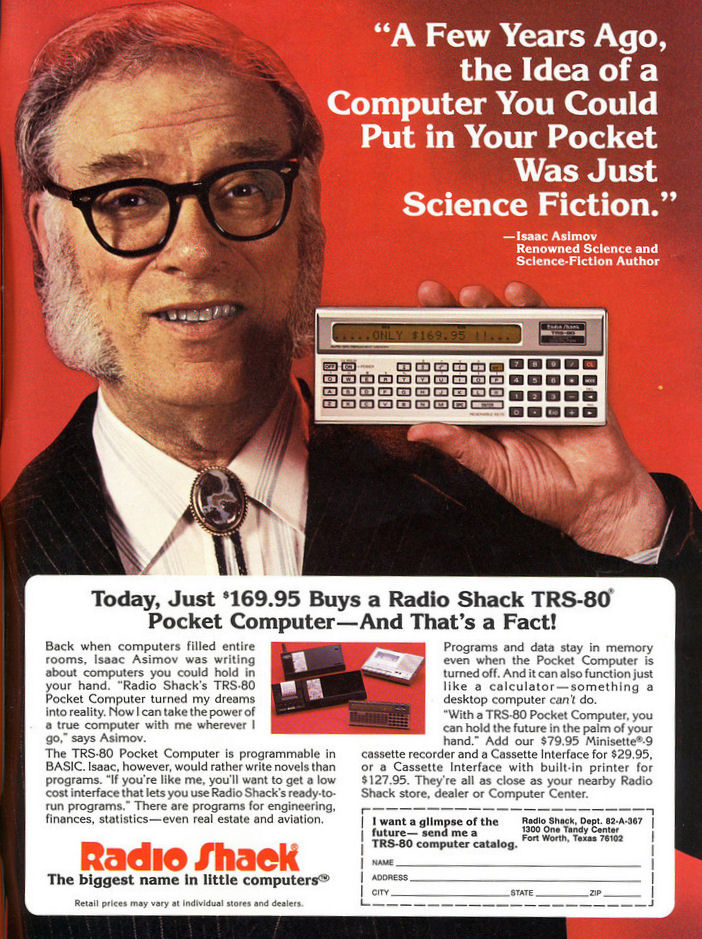
I just ran across an article on Isaac Asimov’s predictions for 2014 from 50 years ago. I was thinking of a blog post to start out the year, and this popped out as a good opportunity. As anyone that reads this blog should know, Isaac Asimov is my favorite writer. His birthday is unknown for certain, but he chose to celebrate it on January 2nd. More information here. Anyway, back in 1964 at The World’s Fair, he made a few predictions. Some of the more accurate ones are below describing video phones, Robots, vehicular robots (Google car?), “Wall Screens” (not quite yet but very close), and a eerily accurate population estimate.

“Communications will become sight-sound and you will see as well as hear the person you telephone. The screen can be used not only to see the people you call but also for studying documents and photographs and reading passages from books. Synchronous satellites, hovering in space will make it possible for you to direct-dial any spot on earth, including the weather stations in Antarctica.”

“Robots will neither be common nor very good in 2014, but they will be in existence.”

“Vehicles with ‘Robot-brains’ … can be set for particular destinations … that will then proceed there without interference by the slow reflexes of a human driver.”

“Wall screens will have replaced the ordinary set; but transparent cubes will be making their appearance in which three-dimensional viewing will be possible.”

“The world population will be 6,500,000,000 and the population of the United States will be 350,000,000.”

Some of the more comical misses are below:

“Mankind will suffer badly from the disease of boredom, a disease spreading more widely each year and growing in intensity. This will have serious mental, emotional and sociological consequences, and I dare say that psychiatry will be far and away the most important medical specialty in 2014.”

“The most glorious single word in the vocabulary will have become work!”

I also have a prediction for today, the birth of a friend’s baby that is now one week overdue. It would be awesome to share a birthday with Isaac Asimov, right?

For the complete list and link to the original article, click the links below.

Via Open Culture

New York Times