The Science Fiction Review Movies,Technology So who wants to control your own personal robot?

So who wants to control your own personal robot?

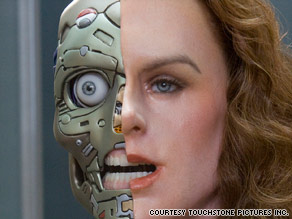
How would you like to control your own personal robot to do your bidding? The new movie Surrogates, starring Bruce Willis, takes this concept to extremes. In the movie, humans link their minds to a robot and control them directly. This is a bit different than being converted to a cyborg like Ray Kurzweil predicts.

As CNN reports:

“Surrogates” director Jonathan Mostow, whose film credits include 2003’s “Terminator 3: Rise of the Machines,” said he was drawn to the concept of surrogate robots as an extension of current technology. And, he said, as he met with scientists, he became convinced that something approaching the concept could one day be a reality.

It seems like the concept of “old fashioned” humanoid robots is  finally becoming outdated. I wonder how Isaac Asimov would feel? It is one thing to boss around a robot using the Second Law of Robotics, but actually mind-melding with one, or becoming one is completely different. The main dilemma in Surrogates is that someone found a way to fry someone’s brain before they were able to jack out of the robot they were controlling. This concept is very old, dating back to the old Virtual Reality plots. I was very interested in the movie when I first saw the trailer, but after reading some lackluster reviews, I think I might just wait for DVD.

The critics could be wrong though. Do any of you think I should give it a chance?

Check out the full article via CNN for more information. I found it to be an interesting read.

Leave a Reply

Your email address will not be published. Required fields are marked *

Please prove you are a human * Time limit is exhausted. Please reload the CAPTCHA.

This site uses Akismet to reduce spam. Learn how your comment data is processed.

Related Post

Blinky, your new best friendBlinky, your new best friend

Quarreling parents, an annoying kid, and a lovable robot make this short film a fun trip into the near future. Who hasn’t wanted a robot playmate of their own? Blinky is no Robbie, but at least he tries. Check the 12 minute movie out for a treat. Be sure to go full screen and turn on HD if your connection can handle it.

—Edit— The original video was taken down for quite some time, but is back!

Blinky™ from Ruairi Robinson on Vimeo.

It looks like the original video was password protected. I found this version with Spanish subtitles.

via Geekologie

Awesome Star Wars Lego Chess SetAwesome Star Wars Lego Chess Set

Star Wars Lego Chess Set

Star Wars Lego Chess Set

I just ran across this excellent Star Wars Lego chess set. It looks like someone made it for the Star Wars Days at Legoland California. The site has an English translation button for those interested in reading more background on the set.

The main gallery is located at http://www.fubiz.net/galleries/set/star-wars-lego-chess/

Check it out!

via Fubiz (original post)

The Age of Spiritual Machines by Ray KurzweilThe Age of Spiritual Machines by Ray Kurzweil

The Age of Spiritual Machines Book Cover
A few months ago a co-worker of mine suggested that I read The Age of Spiritual Machines: When Computers Exceed Human Intelligence by Ray Kurzweil. We had been talking about AI and he mentioned that this was an interesting read. I wasn’t sure exactly what to expect, as I had never heard of Kurzweil before. After a few Google searches I got the impression that he was a quirky futurist.

This book was published back in 1999 and by the end looks very much like science fiction. Many of his predictions are founded on some sort of research. I can see how they would have seemed a bit “out there” almost 10 years ago. I wondered how many of his predictions would hold up. Central to his philosophy is the Law of Accelerating Returns. In short, technology will continue to progress ever faster as time goes on. He displays an interesting graph of the exponential increase of computational power in various models of computers over time. The line is slightly curved upward, which represents an increase in exponential growth over time. So, according to Kurzweil computation is progressing exponentially exponentially faster.
(more…)