The Science Fiction Review Technology Happy Birthday Isaac Asimov – plus predictions for 2014

Happy Birthday Isaac Asimov – plus predictions for 2014

I just ran across an article on Isaac Asimov’s predictions for 2014 from 50 years ago. I was thinking of a blog post to start out the year, and this popped out as a good opportunity. As anyone that reads this blog should know, Isaac Asimov is my favorite writer. His birthday is unknown for certain, but he chose to celebrate it on January 2nd. More information here. Anyway, back in 1964 at The World’s Fair, he made a few predictions. Some of the more accurate ones are below describing video phones, Robots, vehicular robots (Google car?), “Wall Screens” (not quite yet but very close), and a eerily accurate population estimate.

“Communications will become sight-sound and you will see as well as hear the person you telephone. The screen can be used not only to see the people you call but also for studying documents and photographs and reading passages from books. Synchronous satellites, hovering in space will make it possible for you to direct-dial any spot on earth, including the weather stations in Antarctica.”

“Robots will neither be common nor very good in 2014, but they will be in existence.”

“Vehicles with ‘Robot-brains’ … can be set for particular destinations … that will then proceed there without interference by the slow reflexes of a human driver.”

“Wall screens will have replaced the ordinary set; but transparent cubes will be making their appearance in which three-dimensional viewing will be possible.”

“The world population will be 6,500,000,000 and the population of the United States will be 350,000,000.”

Some of the more comical misses are below:

“Mankind will suffer badly from the disease of boredom, a disease spreading more widely each year and growing in intensity. This will have serious mental, emotional and sociological consequences, and I dare say that psychiatry will be far and away the most important medical specialty in 2014.”

“The most glorious single word in the vocabulary will have become work!”

I also have a prediction for today, the birth of a friend’s baby that is now one week overdue. It would be awesome to share a birthday with Isaac Asimov, right?

For the complete list and link to the original article, click the links below.

Via Open Culture
New York Times

Leave a Reply

Your email address will not be published. Required fields are marked *

Please prove you are a human * Time limit is exhausted. Please reload the CAPTCHA.

This site uses Akismet to reduce spam. Learn how your comment data is processed.

Related Post

Kevin Warwick wants to be a CyborgKevin Warwick wants to be a Cyborg

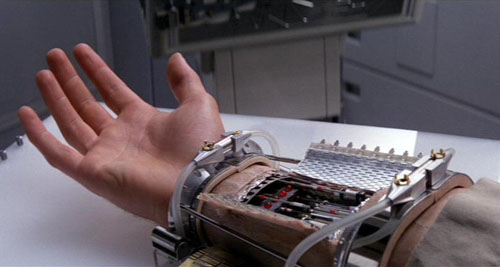
Remember at the end of The Empire Strikes Back where Luke gets his hand chopped off by Vader? During one of the closing scenes, a robot doctor finishes up installing a replacement hand for Luke.

Luke Skywalker's Cyborg Hand

Luke Skywalker's Cyborg Hand

Kevin Warwick did something similar as an experiment, but without the whole getting his hand chopped off step. Instead he put an electrode in his hand that could transmit commands to a robotic hand through radio waves. This was done back in 2002, and somehow I never heard of it. I’m sure Ray Kurzweil would be proud. Check out the video below for more information about how he did this, and some other advances like using rat brain cells to power robots. If you are at all interested in robotics, cyborgs, or AI, you’ll be in for a treat.

Surrogates (2009) Directed by Jonathan MostowSurrogates (2009) Directed by Jonathan Mostow

Surrogates DVD

I wasn’t really expecting much when I heard about Surrogates, so waited to watch it until it came out on DVD. From the previews it looked like many other science fiction action films that seem to be pumped out by Hollywood. The main premise of the movie is that humans live their lives through “surrogate” (robot) bodies. I’m a huge fan of Asimov and his robot novels, so this was enough to catch my attention. The human interface is kind of like how control worked in Avatar, but instead of an organic body as the host, it is robotic. I would definitely not classify the surrogates as the cyborgs that Ray Kurzweil thinks we will eventually become.  One of the main advantages to using a surrogate is that the owner is always protected, so in some ways they are better than cyborgs. There was no way for any harm to come to a user, until now.

Tom Greer, played by Bruce Willis, is in charge of investigating the destruction of a couple of surrogates. This is usually not that big of a deal, but one of the owners is found dead. Whoever wrote the script really wasn’t trying anything new as far as the murder/mystery approach is concerned. I was expecting a lot more action based on the previews that I saw. It felt like I was watching for 40 minutes before things started to get moving. This move was all around average in most respects. Nothing really stood out. It wasn’t bad, but not great.

One completely unrelated observation is that I found Bruce Willis’ upper lip (stash zone) alarmingly long. It looked almost twice the size I’d normally expect. I think of most of the roles I’ve seen him in, he’s got a beard of some sort, so that kind of hides that feature of his face. Am I alone here? Check out the pic on IMDB

Isaac Asimov would have been 90 todayIsaac Asimov would have been 90 today

Nobody is sure when exactly Isaac Asimov was born due to poor record keeping. January 2nd, 1920 was the day Isaac Asimov decided to celebrate his birthday. Along with creating the Three Laws of Robotics, Asimov also unintentionally coined the term robotics. It was first used in print when his short story “Liar!” was published in 1941. He was constantly writing in just about every area of literature. I have primarily read his Science Fiction, but he has done textbooks, humor, mystery, non-fiction, and more.

My first exposure to Asimov’s writing was when my father gave me an old worn out copy of I, Robot. I tucked the book away for a few years and eventually got around to reading it. I was so enthralled with the robots that I eventually read every robot book by him and other authors. This naturally led me to read the Foundation series which I also enjoyed, but I’ve always preferred the robot series. The Robot and Foundation books make up the biggest reading project I have ever completed. Aside from those, I’ve read a bit of his autobiography and plan on sampling some of his other writing in the near future.

By the time I discovered Asimov, he had already died. I wonder how much more he could have written had he not contracted HIV from a blood transfusion he received during heart surgery. He died of myocardial and renal complications on April 6, 1992, but the true cause of his death wasn’t publicized due to the stigma of HIV/AIDS at the time. His work has greatly influenced my love of Science Fiction, and for that I am thankful.

For more information on the life of Isaac Asimov, please visit the official Wikipedia post