If only the Emperor somehow was able to save Padme as well, Darth Vader would have been a little less grumpy!
Meet Mr. and Mrs. Vader
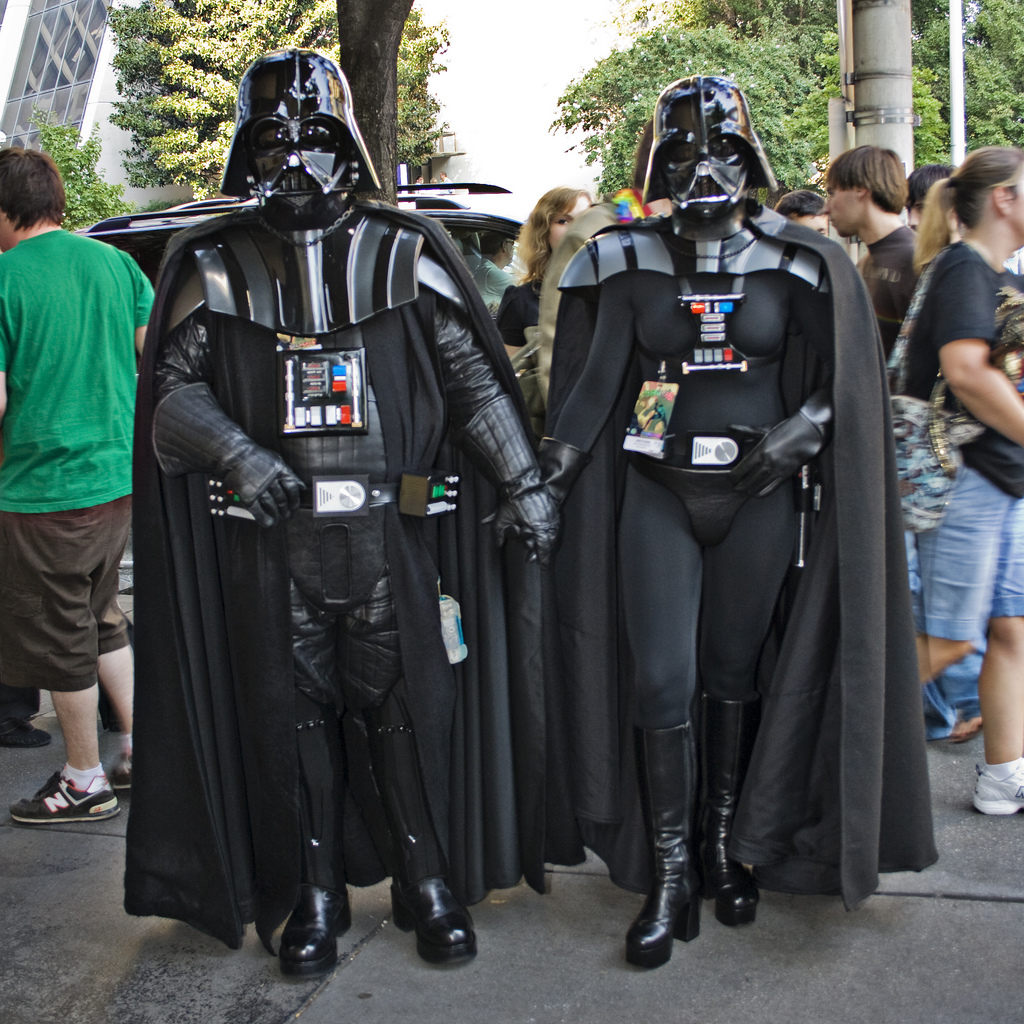
If only the Emperor somehow was able to save Padme as well, Darth Vader would have been a little less grumpy!
Meet Mr. and Mrs. Vader
It looks like Hollywood just can’t get enough of Dune. I’m midway through my reading the novels written by Frank Herbert (currently on God Emperor of Dune), have seen the 1984 movie and Sci-Fi Channel Miniseries. I’m about to watch the Children of Dune Sci-Fi Miniseries and just ran across this bit of news about a new Dune movie.
Found via Variety, actor turned director Peter Berg is set to direct the next adaptation which doesn’t appear to have any type of ETA. Hopefully they will get good script writers that can be faithful to the book. Although the Sci-Fi Channel remake was more true to the book than the 1984, the special effects were pretty bad due to a low budget. Most of the backgrounds were simply matte paintings. I’d like to see a new movie that looks great and is also true to Frank Herbert’s vision.

Today marks the release of Blade Runner – The Final Cut, directed by Ridley Scott. Blade Runner is loosely based on the novel “Do Androids Dream of Electric Sheep?” by Phillip K. Dick. Blade Runner has been one of my favorite Sci-Fi movies since I saw the original Director’s Cut at a friend’s house while in high school. He and his brother insisted that it was the only version worth watching. Consequently, I have never seen the original theatrical release with the happy ending and Deckard’s voiceover narration. From what I’ve read, the studio executives were the main influence for those changes.
To commemorate the release of The Final Cut, which I hope to review sometime soon, I will share my thoughts on the Director’s Cut DVD released back in 1997. I had only seen Blade Runner on VHS back in 1995, and was anxious to see it in the higher resolution and sound quality that DVD had to offer. The video is of poor resolution and visibly shakes slightly, which is annoying. The soundtrack is in just 2 channels, failing to utilize the 5.1 Dolby Digital that DVD offered. I’ve watched it several times over on DVD, and again this weekend, and every time the poor transfer sticks out like a sore thumb. This was one of the first DVD releases, so was barebones with no extra features other than a chapter selection. (more…)

Sunshine is another movie I noticed on a “must watch” Sci-Fi movie list. The premise of the movie is that the Sun is dying, leaving the Earth in a permanent winter. A group of astronauts are riding on the back of a big bomb the equivalent size of Manhattan island. They are supposed to launch the bomb into the sun to kick start it back up to full brightness. Sounds simple enough, right? (more…)